05 — Data and Persistence#
Who this is for. Anyone adding a table, changing a query, touching backup or restore, or debugging "the report says zero and I do not believe it".
What you'll learn. How Ring configures SQLite and why; the repository shape and its deliberate absence of a base class; how migrations work and the one gap no test covers; the restore contract and how it is kept honest; the maintenance latch and writer quiesce; the historian and the two append-only journals; and what exports do.
Authorities this chapter defers to:
docs/production-readiness/09_DB_BACKUP_RESTORE.md
for the backup/restore procedure,
docs/production-readiness/10_AUDIT_TRAIL.md
for what the operator audit trail records, and
docs/CONFIG_AND_STARTUP.md
for the complete on-disk file set.
5.1 One database, resolved to the exe directory#
Ring keeps everything in a single SQLite file, by default
<exe dir>\RingwoodDatabase.db (plus its -wal and -shm sidecars).
The path is normalized at config load by
ConfigurationService.NormalizeConnectionStringDbPath: a relative
Data Source= is rewritten to <exe dir>\<name>, because repositories open the
connection string verbatim and a launch with a different working directory would
otherwise silently create a second database. Absolute paths and :memory:
are left alone (docs/CONFIG_AND_STARTUP.md §2).
For a real plant install, Ring/appsettings.production.template.json is the
starting point, and with Production.Enabled true, validation requires an
absolute DB path and an absolute backup directory
(ConfigurationValidator.cs:106, 112) — see
chapter 02 §2.3, "Production mode — the strict profile"
for the switch that arms this and the rest of what it checks.
Per-connection pragmas#
Every repository opens its own connection per call and applies the same three
pragmas through Ring/Database/RingwoodDbAccess.cs:
PRAGMA busy_timeout = 15000;
PRAGMA journal_mode = WAL;
PRAGMA synchronous  = FULL;
synchronous = FULL is an override, not a default: WAL defaults to NORMAL,
which can lose the last committed transactions on power loss. The class comment
is explicit — "A plant PC must keep the most recent commits, so force FULL
fsync-on-commit" (RingwoodDbAccess.cs:22-27). The 15 s busy timeout exists
because multiple repositories open the same file concurrently; without it,
concurrent access throws "database is locked".
5.2 Repository shape#
Ring/Database/Interfaces/ holds 43 interfaces and
Ring/Database/Repositories/ holds 43 implementations (verified by count).
No ORM, no Dapper — hand-written ADO over System.Data.SQLite.
There is no base class. Each repository is an independent class that:
- opens a connection per call,
- applies
RingwoodDbAccess.ApplyConcurrencyPragmas, - exposes
public static void ApplySchema(SQLiteConnection), which its instanceEnsureTable()also calls.
That static is the single source of DDL truth, shared between first-run creation and migration. Copy the shape from an existing repository rather than inventing a new one; a third pattern is the thing to avoid.
RepositoryReadScope — telling "no rows" from "the read failed"#
Ring/Database/RepositoryReadScope.cs closes a real reporting hazard. Every
list-returning repository traps its exceptions, logs them, and returns an empty
list — deliberately, because a SQL blip must never crash the HMI. But that makes
"the database could not be read" indistinguishable from "there are no records",
so a failed read renders (and emails) as a clean "0 batches in range".
Each repository catch block calls RepositoryReadScope.ReportFailure. A caller
that cares wraps its read in Begin / Capture<T> / Watch and inspects
HadFailure. Callers that do not opt in are completely unaffected — no
signature changes, no behaviour change, no allocation when no scope is active.
Threading constraint: the current scope is [ThreadStatic]. Repository
reads are synchronous ADO calls, so the catch block runs on the caller's thread
— including the report scheduler's STA render worker. A scope must not be held
across an await; keep it around the synchronous read only
(RepositoryReadScope.cs class doc).
The user-facing wording for the distinction lives in one place:
Ring/Services/Reports/ReportDataUnavailableNotice.cs.
5.3 Migrations#
Ring/Database/DatabaseInitializer.cs drives schema evolution with
PRAGMA user_version steps.
- An ordered
MigrationSteplist fromGetMigrationSteps()(:361), each a(version, description, Action<SQLiteConnection>)triple (:331-340). - Steps are applied inside a SAVEPOINT and the version stamped atomically.
- Every step must be idempotent —
CREATE TABLE IF NOT EXISTS, guardedALTER. - Step 1 is the baseline:
new MigrationStep(1, "Baseline schema (all CREATE TABLE IF NOT EXISTS)", _ => { })(:366) — an empty body whose job is to stamp an aged, unversioned database (user_version == 0) up to 1 without altering it. CurrentSchemaVersionis the one constant to bump (DatabaseInitializer.cs:743). Read the file for its value; do not quote one into prose.
SampleDbFileExistence() (:158) is the first-run latch discussed in
chapter 02 §2.2.
TryReadCurrentSchemaVersion() (:198) reads PRAGMA user_version without
creating or touching the database, which is what lets the pre-migration backup
decide whether there is anything worth backing up.
One gap no test covers. If you author a step as
new MigrationStep(CurrentSchemaVersion, …)and forget to bumpCurrentSchemaVersion, you get two steps with the same version. Every test still passes — a fresh database runs both steps — but a plant database already at that version silently skips your migration. Check the number by eye. (Recorded inARCHITECTURE.md.)
5.4 Backup and restore#
Ring/Services/DatabaseBackupService.cs (~646 lines) owns both directions.
Backup uses SQLite's online SQLiteConnection.BackupDatabase API, so the
snapshot is transactionally consistent even while the live app holds connections
open — and so pages still parked in the WAL are flushed into the destination
rather than silently lost. It runs on startup and before every migration, into
%ProgramData%\Ring\backups or the configured
DatabaseMaintenance.BackupDirectory.
Restore is heavier, and the order matters:
- Validate the source —
PRAGMA integrity_checkplus the expected tables being present. - Take an automatic safety backup of the current database to a
.pre-restore-<ts>.baksidecar as rollback insurance. File.Copy, then delete stale-wal/-shmsidecars so the restored database does not open against an alien WAL frame.
The restore contract, and how it stays honest#
Two arrays in DatabaseBackupService define what a backup must contain:
| Array | Line | Applies to |
|---|---|---|
ExpectedTables |
:43 |
a backup stamped at CurrentSchemaVersion or newer — the full table set |
CoreTables |
:144 |
an older backup — the smaller must-have set |
The selection is one line: var requiredTables = userVersion >= CurrentSchemaVersion ? ExpectedTables : CoreTables;
(DatabaseBackupService.cs:496).
Ring.Tests/DatabaseExpectedTablesDriftTests.cs runs the real initializer
against a temp database, reads sqlite_master, and asserts a symmetric
set-difference against ExpectedTables — so the list cannot drift from reality
in either direction without a red test. Ring.Tests/DatabaseBackupServiceTests.cs
holds a mirrored AllTables literal.
The full operator procedure is
docs/production-readiness/09_DB_BACKUP_RESTORE.md;
this book does not restate it.
What the backup does not cover#
The .db file, and nothing else. Not the three JSON stores under
%LocalAppData%\Ring\ — tank_roster.json, operator-session.json,
group_hardware_setup.json — and not the two JSONL journals under
%ProgramData%\Ringwood\Ring\. The tank roster is the one that hurts: it
determines which PLC index a storage-tank write goes to
(chapter 04 §4.3).
Copy that directory by hand before reimaging a plant PC.
(docs/CONFIG_AND_STARTUP.md §4.)
5.5 Health, the maintenance latch, and writer quiesce#
Three cooperating pieces keep the file safe while it is being operated on.
DatabaseHealthService#
Ring/Services/DatabaseHealthService.cs runs the three operations a live plant
database needs:
- Startup
PRAGMA integrity_check— early warning of corruption from a bad shutdown, disk bit-rot or tampering. Failures are logged and surfaced; the policy choice is the operator's. - Startup online backup into the configured directory, plus a retention
prune to the newest
DatabaseMaintenance.RetentionCountauto-files. - Shutdown
PRAGMA wal_checkpoint(TRUNCATE)— flushes every dirty WAL frame into the main file and zeroes the WAL, so the sidecar is safe to delete after the process exits. Without it, a power cut between SQLite's automatic checkpoint (every 1000 dirty pages) and the next start can lose committed rows that an operator then "cleans up" by deleting the WAL.
It also runs background maintenance on a timer and has a bounded 10 s join in
StopBackgroundMaintenance — the model the polling coordinator's drain copies.
DatabaseWriterQuiesce#
Ring/Services/DatabaseWriterQuiesce.cs stops — and puts back — every
background writer that can touch the database, so a file swap (restore) or
delete (factory reset) cannot race a timer tick into the file being replaced.
Its existence is a lesson about duplicated lists. Both dialogs previously
carried a byte-identical inline list of four services, and that list was
incomplete: BatchStepsPoller, InventoryEventCaptureService,
AlarmAlarmNumberPlcService and ReportSchedulerService all kept running.
"Two copies of an incomplete list is exactly the shape that stays incomplete, so
there is now one list, in one place, used by both dialogs."
Two design properties:
- Best-effort, per writer. Every stop and every resume is individually guarded: a writer that fails to stop must never block the restore, and a writer that fails to resume must never stop the others coming back.
- Resume fidelity. Each entry reports whether it was actually running before
the stop, and
ResumeAllonly restarts what it actually stopped — so quiescing never silently arms a recorder the site had deliberately left off. Resume runs in reverse order.
On the PLC side it uses PlcPollingCoordinator.PauseDatabaseWriters(), which
stops only BatchStepsPoller and leaves the read-only pollers live, so the
operator's screens are not blacked out for the duration
(chapter 03 §3.2).
DatabaseMaintenanceLatch#
Ring/Services/DatabaseMaintenanceLatch.cs is a process-wide "the database file
is being swapped or deleted right now — do not touch it" flag, held by
DatabaseWriterQuiesce.StopAll and released only by ResumeAll.
The reason it is needed on top of the quiesce is precise and worth
internalising: the restore and reset dialogs put a modal MessageBox up
around the swap, and a modal message box runs a nested dispatcher pump.
Anything already scheduled on the dispatcher keeps running inside that window,
and two things there can undo the quiesce:
- The PLC auto-reprobe.
MainWindow.PlcAutoReprobeTick(30 s) marshalsStartPlcMonitoring()onto the dispatcher, which runsPlcPollingCoordinator.Start()— clearing the batch-steps pause — and restartsInventoryEventCaptureServiceandViscometerLiveRecorder. - Dashboard refresh ticks.
DashboardView's 4 s and 60 sDispatcherTimers run repository reads, and every repository call begins withEnsureTable(), which issuesCREATE TABLE / CREATE INDEX IF NOT EXISTS. Opening a SQLite connection creates the file, so after a factory reset a read alone is enough to leave a partially-schema'dRingwoodDatabase.dbon disk — which defeats the first-run detectionSampleDbFileExistenceexists to protect and hands the next launch a half-built database it will treat as an upgrade.
The latch is never released on the paths that end in
Application.Current.Shutdown(), which is the point.
5.6 Batch lifecycle and history#
BatchStepsPoller observes current_step edges and drives
Ring/Services/Batch/BatchLifecycleRecorder.cs, which on batch end calls
BatchRepository.CompleteWithUsage. Completion and every IngredientUsage
row commit in one transaction — if a usage insert fails, the batch stays
Running rather than completing with missing usage. (Older runbooks describe
this as an open "Phase A" gap; it shipped, and
ARCHITECTURE.md records the
closure.)
Two startup catch-ups run on a background task from
PlcPollingCoordinator.Start() (:165-180):
- Orphan reconcile — closes
Batchrows leftRunningby a crash or reboot, but never interrupts a batch the plant is genuinely running. Its branch selection is factored into the pure, testablePlcPollingCoordinator.DecideStartupReconcile(:459-492) with three rules: any active read wins (reconcile only the other tanks, or defer if the active tank cannot be attributed); any failed read defers (a failed read is never a confirmed idle); otherwise it needsBatchStepsPoller.IdleConfirmReadsRequiredconfirmed idle reads before closing anything. The debounce exists because a between-stepscurrent_step == 0flap during a restart used to mark the live batch Interrupted and spawn a duplicate row. - Missed controller verdicts —
BatchStampsBackfillServiceattaches the controller's retained batch summaries for batches that finished while Ring was down. Deliberately bulk-only, no indexed fallback: four 40-element fallbacks would be 160 sequential reads in one burst against a controller whose EIP session table is the scarce resource, and "a missed verdict is a cosmetic loss where a starved session table is not" (PlcPollingCoordinator.cs:224-233).
Related history services:
Ring/Services/Batch/BatchHistoryBackfillService.cs (preview-first importer for
the legacy six-month history), BatchStampsMatcher.cs (which controller stamps
slot belongs to which Ring batch), and
Ring/Services/LegacyRs360ImportService.cs.
5.7 The historian#
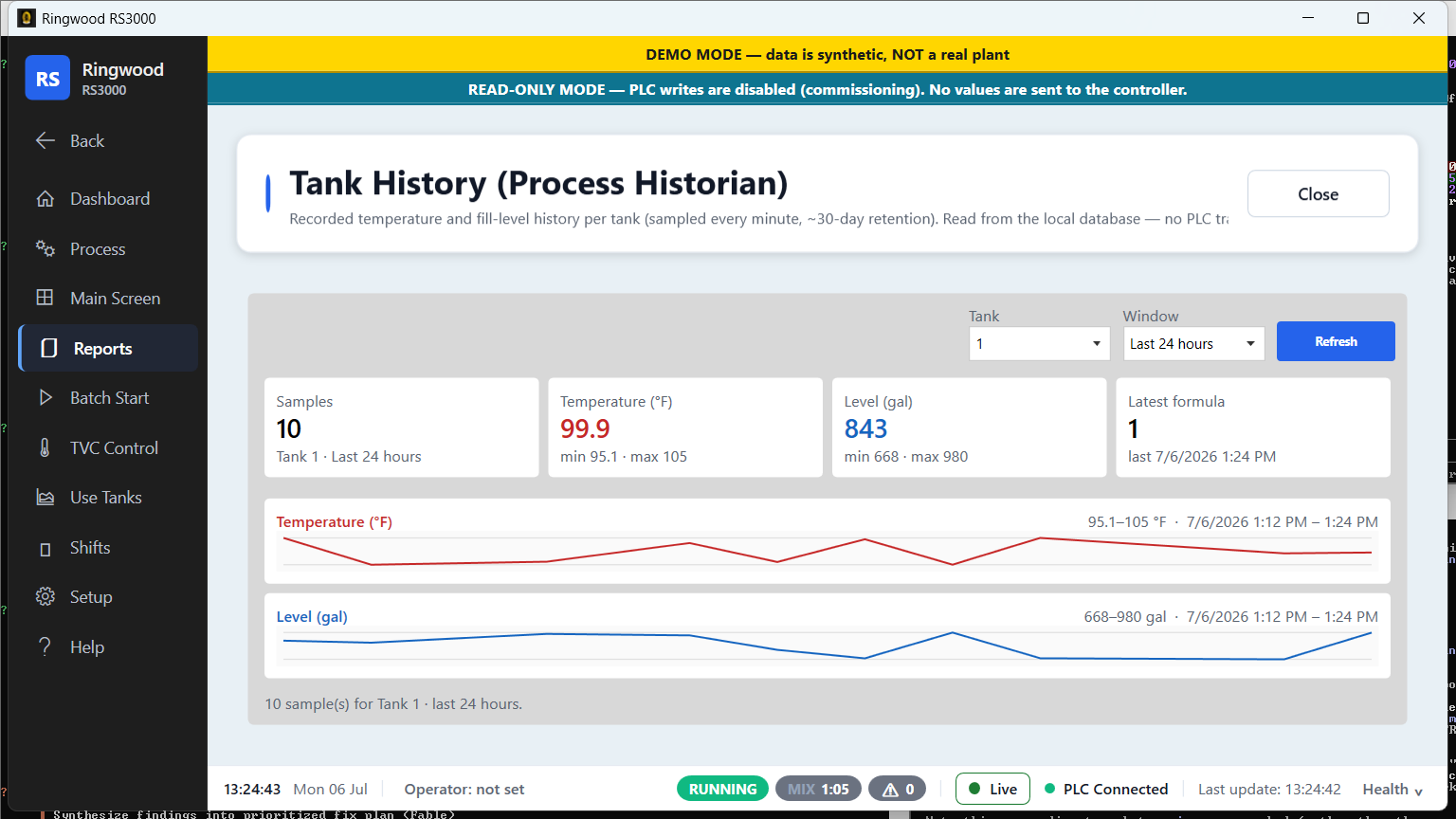
Ring/Services/ProcessHistorianService.cs is a singleton background service
that, on a configurable cadence (DefaultCadenceMs = 60_000), reads the
existing in-memory StorageTanksSnapshotHolder.Latest and persists one
ProcessHistorySample row per installed tank. It performs no new PLC reads.
Two properties that make it safe to leave on:
- It samples only while
PlcHeartbeatConnectionTracker.AllowHeavyPlcPolling()is true, so a starved or dead link never writes confident-looking frozen rows. - Retention prune runs on a coarser schedule (
RetentionPruneEveryTicks) — every 60 sample ticks at the default cadence, i.e. roughly hourly. The window isDatabase.ProcessHistorianRetentionDaysin appsettings.json, editable on Setup → Database Backup → "Data retention" (default 365 days;0means keep forever). Corrected 2026-09-01: this used to be a hardcodedProcessHistorianService.DefaultRetentionDays = 30constant with no config surface at all — the constant still exists as the fallback when no setting is present, but the shipped app always passes the configured value. A change only takes effect after Ring is restarted (the value is baked into a DI-constructed singleton at startup, not re-read live).0never triggers a full-table scan —ApplyRetentionDaysreturns immediately on a non-positive value without opening a connection. - Alarm history (
PlcAlarmEvents,AlarmLifecycle) has an equivalent, independently-configurable window:AlarmSettings.AlarmHistoryDays(default raised 2026-09-01 from 30 to 365 days;0= keep forever), same Setup field. Unlike the historian value, this one is re-read on every alarm tick (AlarmAlarmNumberPlcService), so a change applies immediately — no restart required.
For what this cadence and retention window mean in rows-per-year, and why the row count is a query-latency non-issue, see chapter 03 §3.9 — not repeated here to keep the growth arithmetic in one place.
Ring/Services/RuntimeAccumulatorService.cs follows the same shape for
accumulated equipment runtime, and Ring/Services/TankLevelTrendService.cs is
an additive, read-only time-to-empty estimator over the same snapshots.
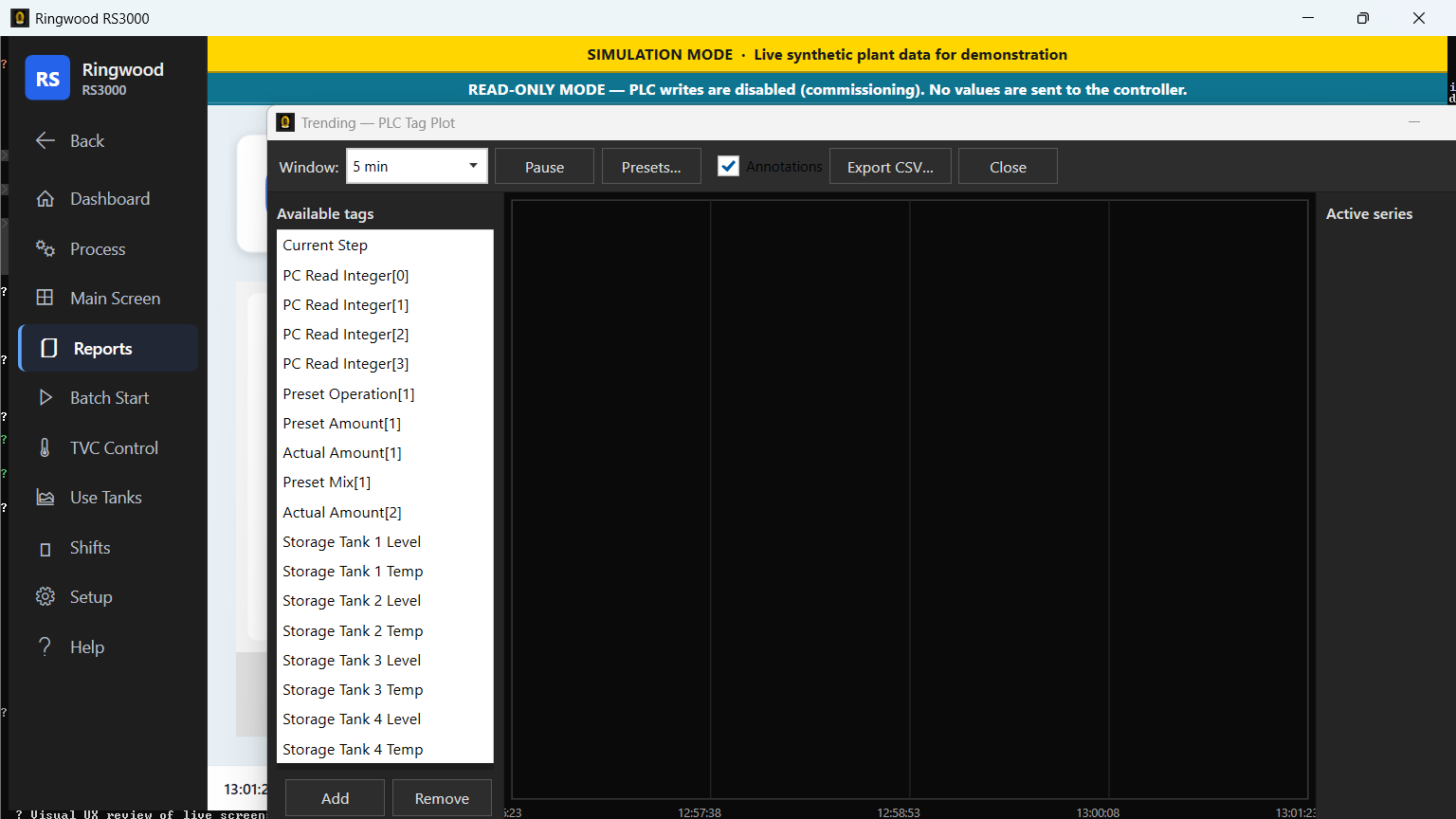
Ring/Services/PLC/TrendingDataService.cs is the exception in this family — it
does construct its own PlcTagReader per non-snapshot tag on every 2 s tick
(PollIntervalMs = 2000, :32).
5.8 The two append-only journals#
Neither lives in SQLite, and neither is covered by any backup.
UiAuditJournal — the tamper-evident operator trail#
Ring/Services/Audit/UiAuditJournal.cs, at
%ProgramData%\Ringwood\Ring\ui-audit\ui-audit.jsonl (:1040-1041).
Integrity chain. Every record carries the previous record's hash, and
VerifyChain re-derives every hash over the supplied files in order and reports
the first break (:377-...). A separate UiAuditTailAnchor written beside the
journal closes the one hole a backward chain cannot: a tip on disk that is
behind the anchored tip means the journal was truncated (:71-90).
What the chain is and is not — the class states its own limits (:116-120):
the hash is a plain, unkeyed SHA-256. It reliably detects accidental
corruption and casual edits; someone with the same code and the patience to
re-hash every downstream record can produce a self-consistent forgery. It is
tamper-evident, not tamper-proof.
Writer-thread-only state means the chain is race-free without a lock: only the
writer ever assigns a sequence number or a hash (:158-159).
Collaborators: UiActionAuditor (app-wide, observe-only capture of operator
interactions), UiActionRecord / UiActionKinds, UiAuditQueryService (the
UiAuditTrailScreen read model), and UiScreenResolver, which answers "which
screen was the operator looking at?".
UiScreenResolveris part of the rename freeze. It writesGetType().Nameinto the hashed record payload, so renaming a screen class splits its identity across the rename boundary: old records still verify but no longer match live labels (ARCHITECTURE.md).
What the trail records for operators is
docs/production-readiness/10_AUDIT_TRAIL.md.
PlcWriteEvidenceJournal#
Covered in chapter 04 §4.9,
including the important scope limit: only writes that go through
PlcSetpointWriteQueue produce evidence lines.
Ring/Services/Audit/IncidentExportBuilder.cs reads both journals back for an
incident export.
5.9 Exports and reports#
Database export. Ring/Services/Export/DatabaseExportService.cs streams
selected columns from a whitelisted table to CSV. The whitelist is
Ring/Services/Export/DatabaseExportSchema.cs — a static
IReadOnlyList<DatabaseExportTable> Tables (:19) with a lookup by name
(:141). A table that is not in that list cannot be exported, which is the
point: the export form takes a table name from the UI.
Ring.Tests/DatabaseExportSchemaSmokeTests.cs exercises it.
Full database export. Ring/Services/Export/SqlDumpService.cs is a
second, independent export path — schema-generic rather than whitelisted: it
reads sqlite_master directly (skipping only internal sqlite_% bookkeeping
objects such as sqlite_sequence), so it is not limited to
DatabaseExportSchema's curated table list. DumpDatabase opens its own
connection, applies RingwoodDbAccess.ApplyConcurrencyPragmas (§5.1) like
every other repository, and runs the whole read — schema, then every table's
rows — inside one read transaction, so the resulting .sql script is a
consistent point-in-time snapshot even while the rest of the app keeps
writing on other connections. The output is streamed to a .partial sibling
file, FileStream.Flush(true)-fsynced, and only then renamed to the final
<name>.sql name — write-to-temp-then-atomic-rename, so a crash mid-export
can leave at most a stale .partial file, never a final-named file that
looks complete but is truncated. Ring.Tests/SqlDumpServiceTests.cs covers
it, including the interrupted-before-rename case.
This is a separate guarantee from the live database's own durability:
RingwoodDbAccess.ApplyConcurrencyPragmas (§5.1) already configures every
SQLite connection in the app with journal_mode = WAL and synchronous = FULL — fsync on every commit, stronger than the NORMAL floor typically
recommended for WAL — which is what protects RingwoodDatabase.db itself
against corruption or a lost commit on a power outage. SqlDumpService
inherits that same protection for its own connection, but the two exist for
different failure modes: the pragmas protect the live file continuously; the
.sql export is a one-shot, portable snapshot an operator or IT can hand off
or replay into a brand-new database. Ring.Tests/RingwoodDbAccessTests.cs is
regression coverage added alongside this work for the pragma configuration,
which previously had none.
Reports. Ring/Services/Reports/ holds the query services (read-only
aggregations over persisted data), the pure calculators, and the
*ReportDocument builders that produce WPF FlowDocuments for on-screen
preview and PrintDialog output. PdfExportService renders a FlowDocument to
PDF. ReportSchedulerService (1-minute timer) drives subscription emails via
ScheduledReportRenderer, with due-math in the pure
ReportScheduleCalculator. Chapter 07 catalogues them.
Diagnostics. Ring/Services/DiagnosticBundleService.cs builds a one-click
support zip.
Plant profile. Ring/Services/PlantProfileService.cs builds a versioned
*.ringprofile.json commissioning export. Note from
docs/CONFIG_AND_STARTUP.md §3 that a plant-profile import deliberately does
not carry the PLC IP or ReadOnlyMode.
5.10 Adding a table — the whole checklist#
Reproduced from ARCHITECTURE.md
because it is the one place a partial change silently succeeds:
- Write
IXRepository+XRepositorywith the per-call connection +ApplyConcurrencyPragmasshape. - Expose
public static void ApplySchema(SQLiteConnection); haveEnsureTable()call it. - Append a
MigrationStepat the end ofGetMigrationSteps()that callsXRepository.ApplySchema. - Bump
CurrentSchemaVersion(DatabaseInitializer.cs:743). Three tests fail if you forget in the ordinary case —DatabaseSchemaMigrationTests.CurrentSchemaVersion_Matches_HighestMigrationStep(:47),DatabaseExpectedTablesDriftTests.CurrentSchemaVersion_MatchesInitializerLatest(:120), andDatabaseSchemaMigrationTests.Wave6Migrations_CreateBothTables_AndStampCurrent, which asserts the version as a literal (:139-140) and therefore has to be edited too. But see the same-version gap above, which no test catches. - Add the table name to
ExpectedTablesinDatabaseBackupService(:43).DatabaseExpectedTablesDriftTests.ExpectedTablesExactlyMatchesWhatInitializeActuallyCreates(:93) fails in both directions if this and step 3 disagree. You do not normally touchCoreTables(:144). - Mirror it in the
AllTablesliteral inRing.Tests/DatabaseBackupServiceTests.cs:38. - Register the repository in
ServiceCollectionExtensions. - Register both new
.csfiles inRing/Ring.csproj(chapter 08). - Have the repository's catch blocks call
RepositoryReadScope.ReportFailure(§5.2) so a failed read is distinguishable from an empty result. - If a background timer will write the table, add it to
DatabaseWriterQuiesce(§5.5).
The step-by-step version, with the reasoning inline, is chapter 10 §10.5.
Next: 06 — UI Architecture.
Verified against#
Every claim in this chapter was read out of these files on 2026-09-01:
Ring/Database/ — DatabaseInitializer.cs, RingwoodDbAccess.cs,
RepositoryReadScope.cs, Interfaces/ and Repositories/ (listings),
Repositories/BatchRepository.cs ·
Ring/Services/DatabaseBackupService.cs, DatabaseHealthService.cs,
DatabaseWriterQuiesce.cs, DatabaseMaintenanceLatch.cs,
ProcessHistorianService.cs, RuntimeAccumulatorService.cs,
DiagnosticBundleService.cs, PlantProfileService.cs ·
Ring/Services/Audit/UiAuditJournal.cs, IncidentExportBuilder.cs ·
Ring/Services/Export/DatabaseExportSchema.cs, DatabaseExportService.cs,
SqlDumpService.cs ·
Ring/Services/Batch/ (listing) · Ring/Services/PLC/PlcPollingCoordinator.cs ·
Ring.Tests/DatabaseExpectedTablesDriftTests.cs,
DatabaseBackupServiceTests.cs, DatabaseSchemaMigrationTests.cs,
SqlDumpServiceTests.cs, RingwoodDbAccessTests.cs ·
docs/CONFIG_AND_STARTUP.md · ARCHITECTURE.md