# 10. Watching the HMI from another PC (Ring Remote View)
*Canonical HTML version: https://ring-rs3000.pages.dev/docs/operator/10-remote-viewing.html*
*Screenshot: My Devices — the HMI PC listed in the Plant HMI group. (https://ring-rs3000.pages.dev/assets/shots/app/remote-view-04-devices.png)*
**Ring Remote View** is a separate, optional add-on. It is not part of Ring
itself, and not every station has it installed — ask your supervisor if you
aren't sure. This chapter is for the two people involved in a session: the
operator standing at the HMI panel, and the person watching from somewhere
else. If you need to install, provision, or remove the add-on, that's a
different job — see
[Installing Ring Remote View](../installer/07-remote-view.md).
## 1. What it is, in one minute {#what-it-is}
Ring Remote View lets somebody else look at the exact same Ring screen you
have in front of you. Nothing about it changes what Ring does:
- **It's a mirror, not a second copy.** Nobody logging in remotely starts a
second Ring. There is still one Ring, one screen, one connection to the
controller — the remote viewer just sees a copy of what's already there.
- **The controller is never touched by this add-on.** Remote View has no
path to the PLC of its own. Any button-press that reaches the controller
still goes through Ring, the same as if you'd pressed it yourself.
- **Watching is the default. Driving needs permission.** Most remote
accounts are set up view-only — they can see the screen and nothing else.
A named few are set up so they *can* move the mouse and type, and even
then, only after the person at the panel lets them in for that session.
- **Every session is recorded.** Remote View keeps a video recording of
what happened, the same way a camera would. That's kept as evidence, not
deleted when an account is removed.
The rest of this chapter covers the two sides of a session in turn: what
you do if you're the one standing at the panel, and what you do if you're
the one connecting from somewhere else.
## 2. If you're the person at the panel {#at-the-panel}
You don't need an account for this. Remote View only affects you when
someone tries to connect, and it asks you first for every new connection —
unless someone at the panel has just ticked the "auto accept" checkbox
described below, which waves the next five minutes of requests through
without asking again.
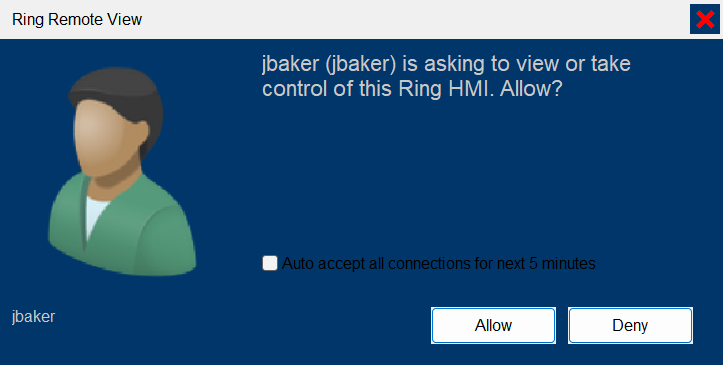
**The prompt.** When someone clicks Connect from their end, your screen
shows a notification followed by a prompt naming exactly who is asking —
for example:
> **Ring Remote View**
> *jbaker (jbaker) is asking to view or take control of this Ring HMI.
> Allow?*
with a checkbox **"Auto accept all connections for next 5 minutes"** and two
buttons, **Allow** and **Deny**.
What the person at the panel sees: who is asking, Allow or Deny.
- **Allow** lets that session start. They'll see your screen from that point
on, and — only if their account is set up for it — be able to move the
mouse and type.
- **Deny** refuses it. Nothing is shown to them, ever, for that attempt.
- **Leave the "auto accept" checkbox unticked** unless the whole shift has
agreed to it in advance. It's there for MeshCentral (the software behind
Remote View), but ticking it means the *next* five minutes of requests get
in without asking you again — not something to do on a whim on a live
glue kitchen.
**If nobody answers, the answer is no.** If the prompt sits on screen for
about a minute with no response, the request is refused automatically and
the other end is disconnected. There is no setting anywhere that lets an
unattended panel wave a connection through — that's deliberate.
**"The panel has priority."** This is the etiquette the controls engineer
signed off on, and it applies every time, not just when something feels
wrong:
1. **The operator standing at the HMI wins every disagreement, always.**
If you're not comfortable with someone driving, say so and take it back.
2. **One controller at a time.** Everyone else who's watching stays
view-only while someone else is driving.
3. **Whoever is remote should announce before taking control** — a radio
call or a phone call, not just the prompt appearing. If a prompt shows up
with no warning, that's your cue to ask why before you click Allow.
4. **Deny anything you didn't expect**, and mention it to your supervisor.
An unannounced prompt is a "no," not a click-through.
5. **A Terminal or Files prompt should be impossible.** Remote accounts are
set up so they can never open a command line or browse files on this PC
— only the screen. If you ever see a prompt asking for anything other
than viewing/driving the desktop, **deny it and tell your supervisor
right away** — it would mean something about the setup has changed.
6. **Say when you let go.** If you handed control to someone remote, say
"you have it back" out loud when you're taking the mouse again, the same
as you would with anyone else standing at the panel.
## 3. If you're the remote person {#remote-person}
This is the other side of the same session — what to do if you're the one
connecting from an office PC, or, if the plant has enabled that option,
from home.
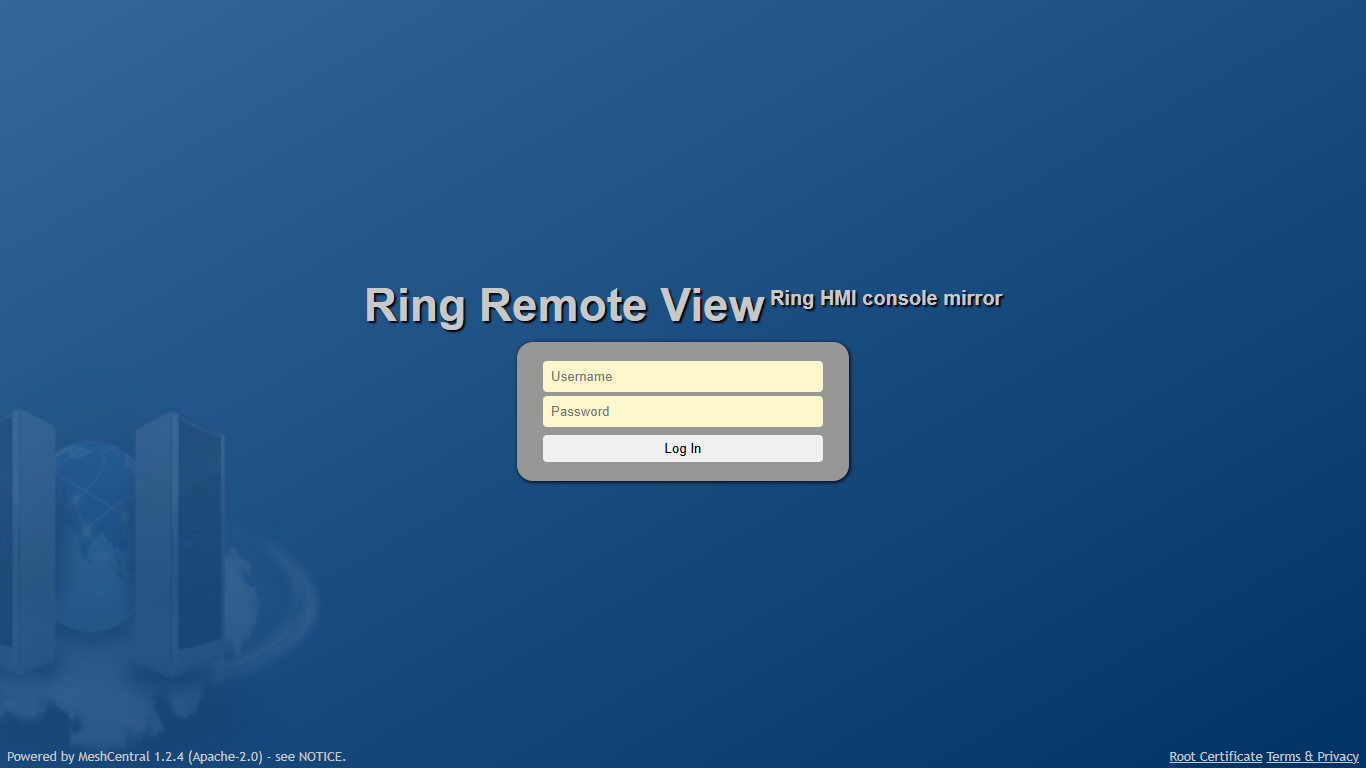
1. **Open a browser and go to the address you were given.** Usually that's
the HMI computer's name, something like `https://:8443/`, though
some plants hand out its numeric LAN address instead — either form can
work, as long as it's the exact address issued for this HMI. If your
office has bookmarked this for you, it's the same address. Remote View
only accepts a short, specific list of addresses for a given HMI PC; if
you type something that isn't on that list, the page loads only as far
as:
**"Invalid origin in HTTP request, click to reconnect."** If you see
that, go back and use the exact address you were handed rather than
guessing at a variation of it.
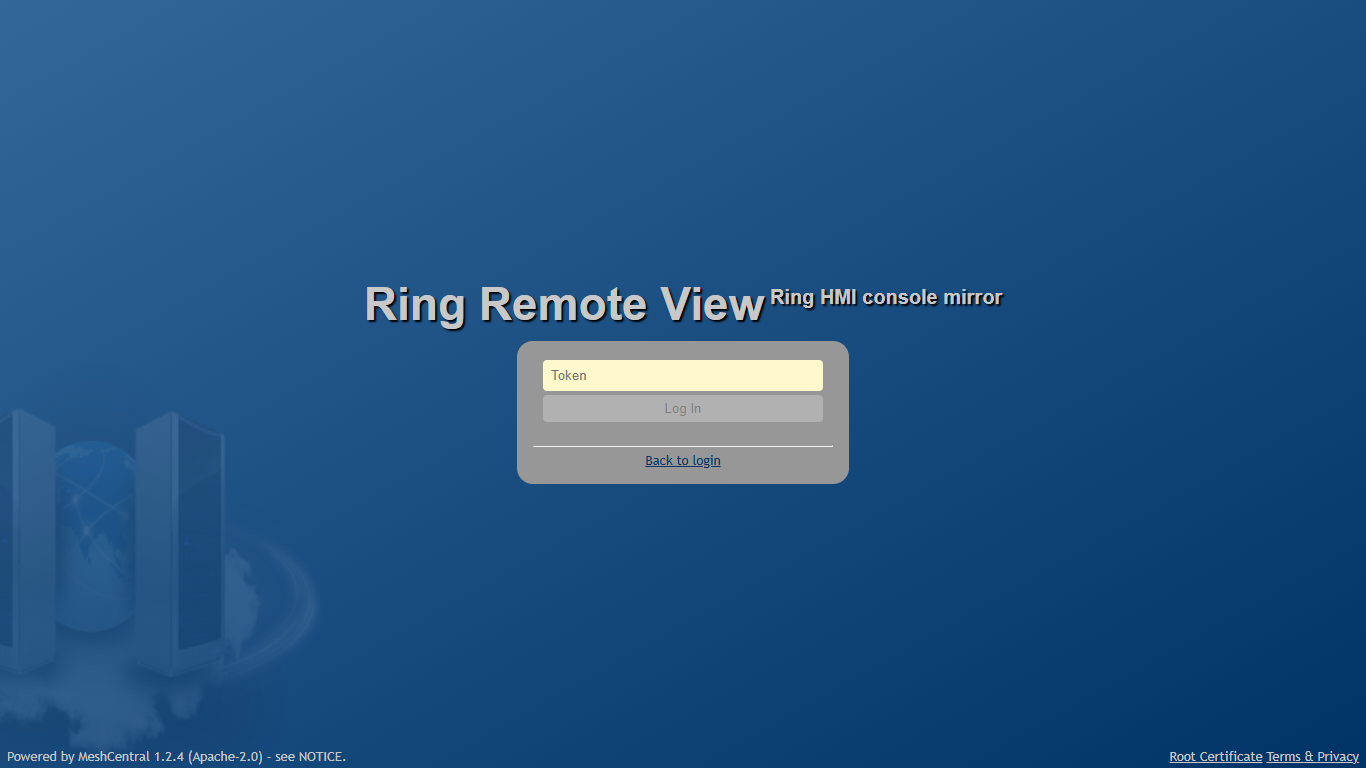
The Ring Remote View login page in a browser.
2. **Accept the certificate warning, once.** Your browser will warn you the
site's certificate isn't from a recognized authority. That's expected —
there's no in-plant certificate authority, and the plant's Remote View
server is LAN-only with its own self-signed certificate. Trust it and
continue; you'll only be asked once per browser or device.
3. **Log in** with the username and one-time password you were handed in
person. (It should always be handed to you in person or by phone, never
by email.)
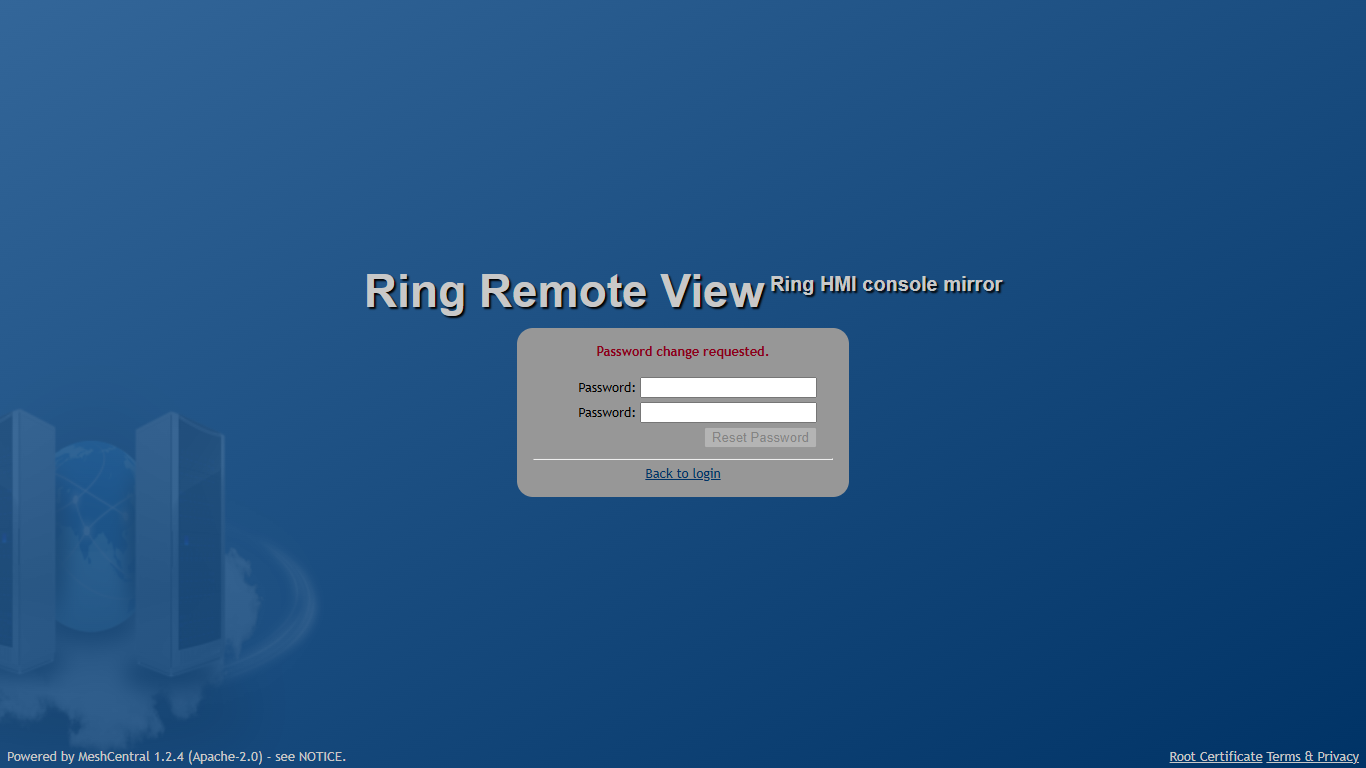
4. **Change the password when it asks you to.** The one-time password only
works once. The first time you log in you'll land on a page titled
"Password change requested." with two password fields — set a real
password there before you continue.
First login: the one-time password must be changed.
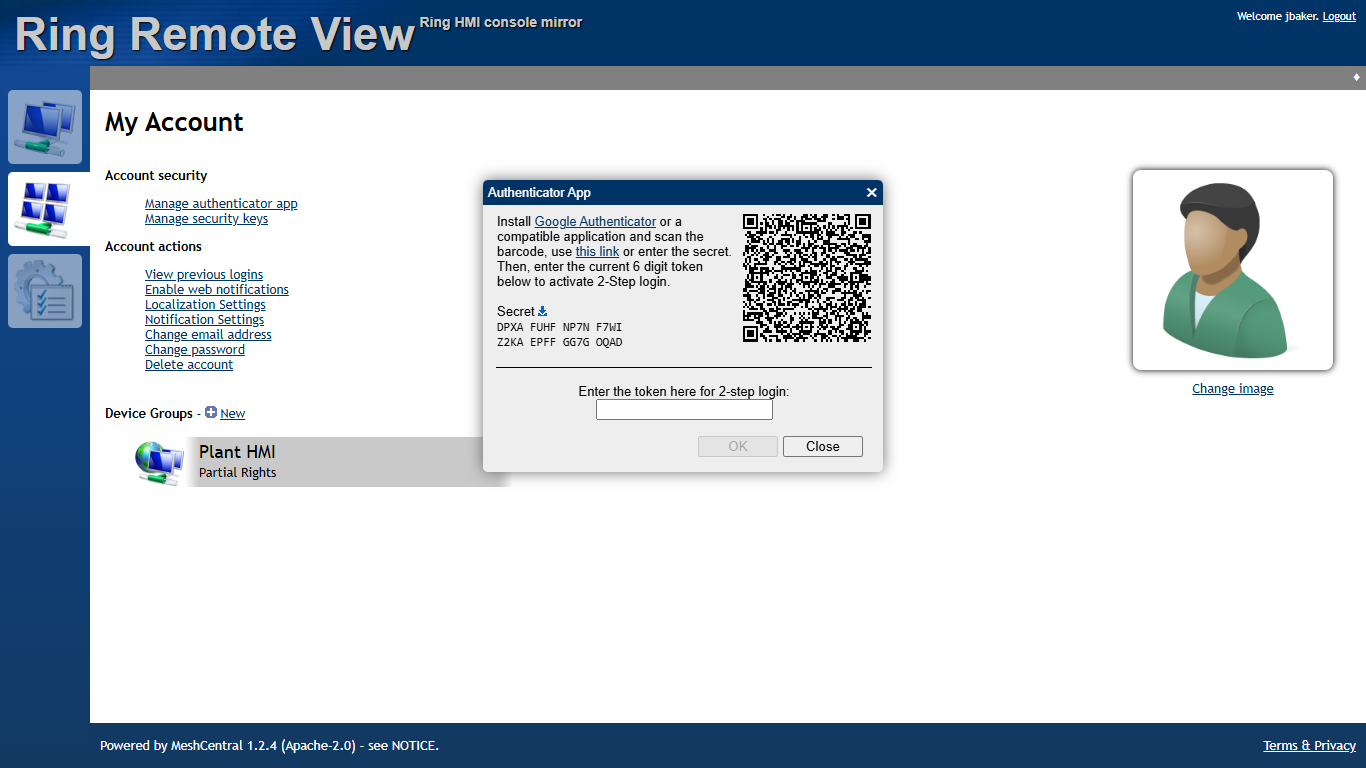
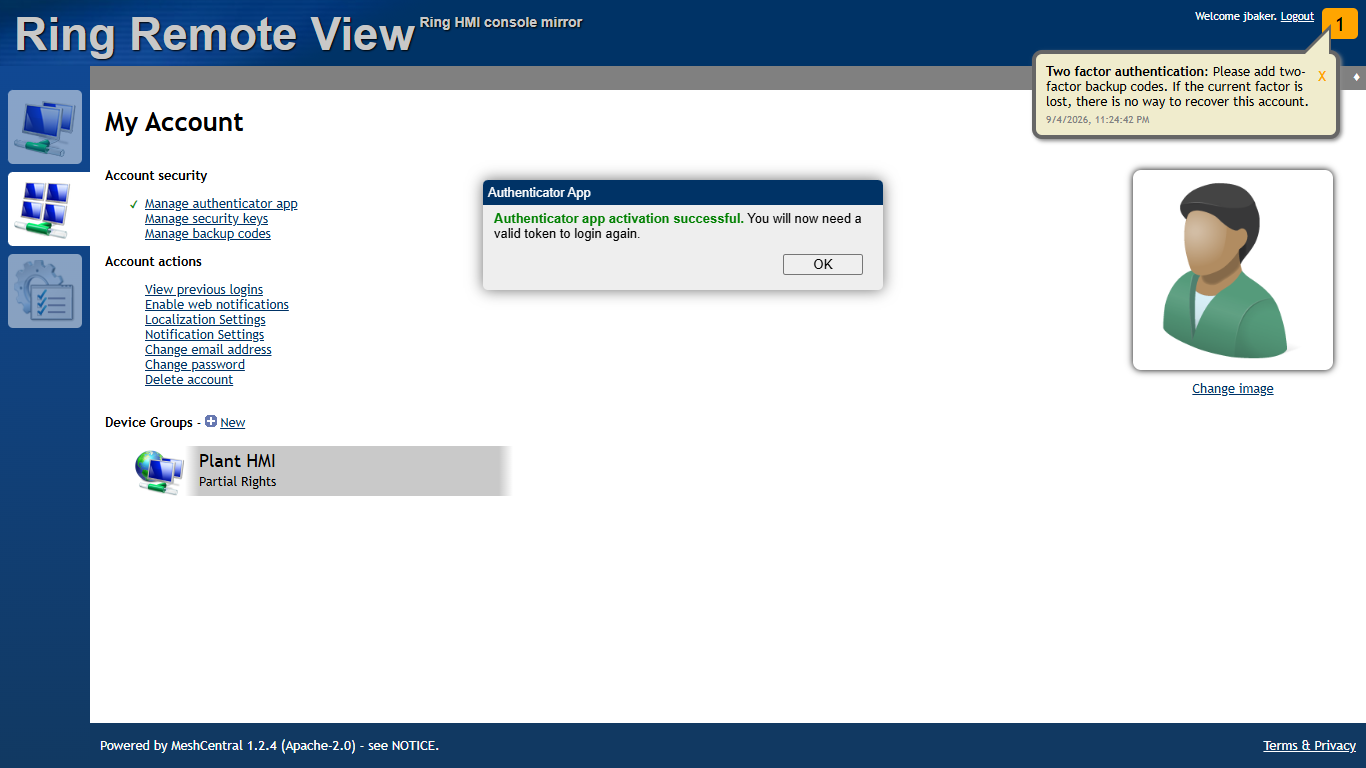
5. **Set up your authenticator app.** Every account on this system — yours
included — must enrol a phone authenticator app (like Google
Authenticator) before it can do anything else. Go to **My Account →
Account security → Manage authenticator app**, then either scan the QR
code with your app or type in the secret shown next to it, and enter the
current 6-digit code from the app to confirm.
My Account, Account security, Manage authenticator app: scan the code or type the secret, then enter the current 6-digit token.
**Until you've done this, opening the HMI device shows a dead end
instead of a screen** — the message reads: "Unable to access this
feature until two-factor authentication is enabled. This is required for
extra security. Go to the "My Account" tab and look at the "Account
Security" section." Enrolling is the fix — it's a one-time step.
From then on, every later login asks for a fresh 6-digit code after your
password, on its own page.
Every later login asks for the 6-digit code from the authenticator app.
6. **Find the HMI on My Devices.** Once you're past login, you land on **My
Devices**. Find the **Plant HMI** group and the HMI PC's entry inside it.
My Devices: the HMI PC in the Plant HMI group.
7. **Open the device, click the Desktop tab, then Connect.** Your account
only shows the tabs it's allowed to use — most remote accounts see just
**General, Desktop** and **Events**. If you don't see a **Terminal** or
**Files** tab, that isn't a mistake — those are switched off for remote
accounts on purpose, so nobody watching the HMI can open a command line
or browse the PC's files from here.
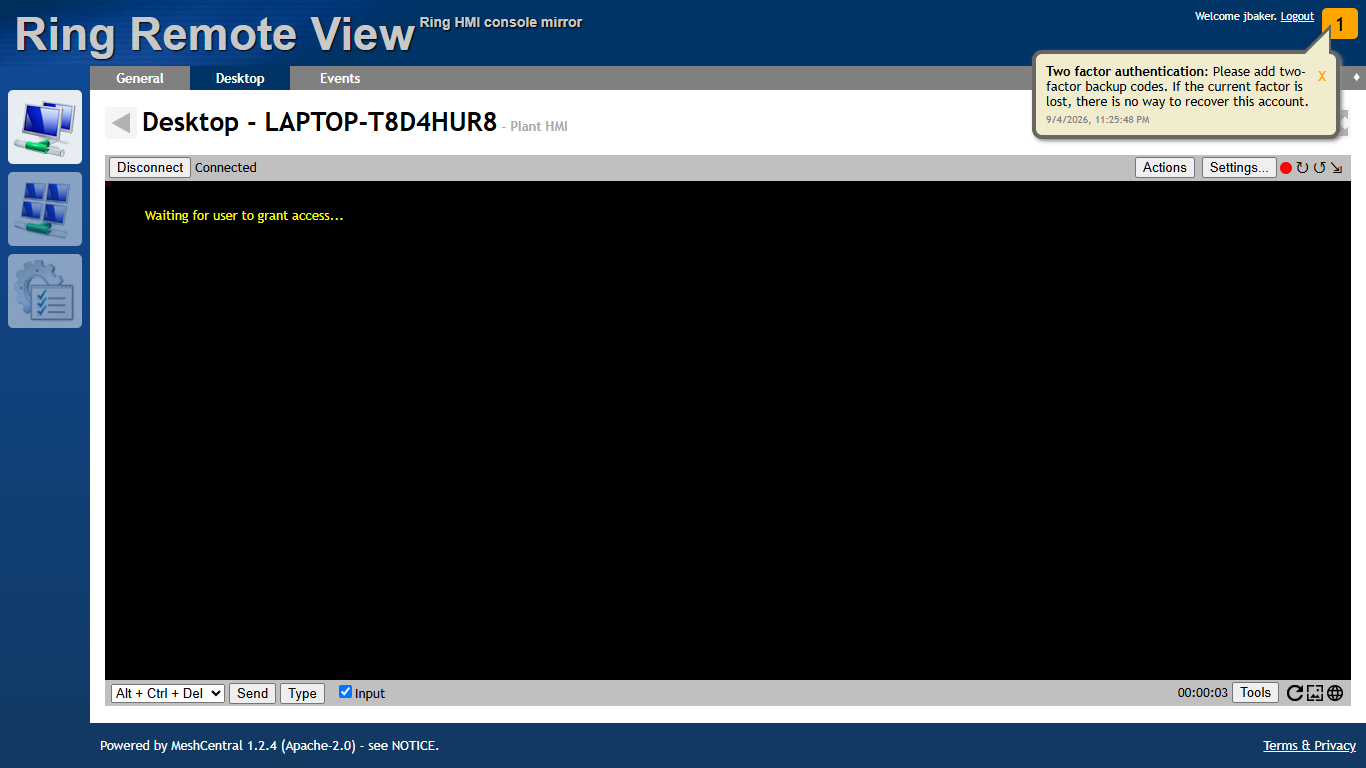
8. **Wait for the person at the panel to let you in.** After you click
Connect, the Desktop tab shows **"Connected"** at the top and
**"Waiting for user to grant access..."** where the screen will appear.
Nothing is shown to you until the operator at the panel clicks Allow —
there is no way to see the screen before they answer.
Desktop tab after Connect: "Waiting for user to grant access..." while the person at the panel decides.
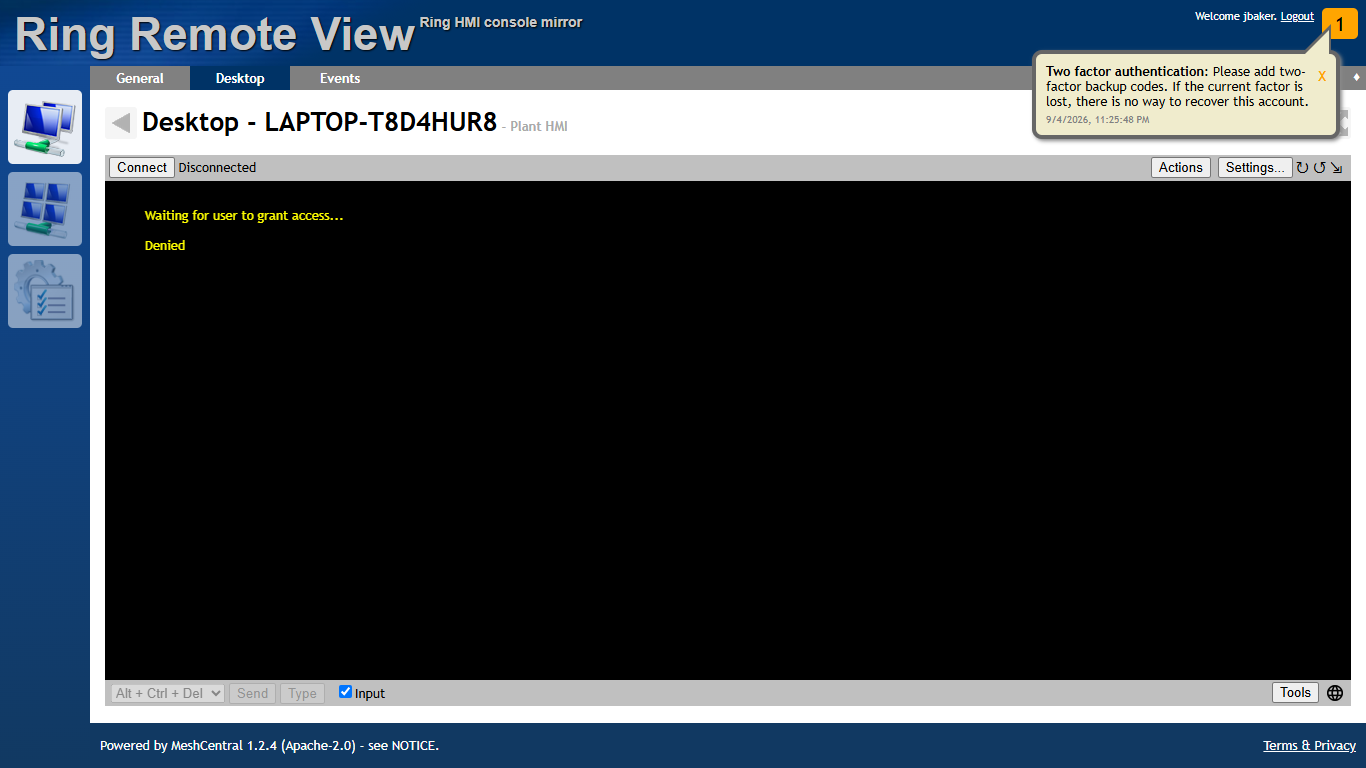
If nobody is at the panel, or the operator doesn't respond, the wait
ends on its own after about a minute and the tab goes back to
**"Disconnected"** — you never saw anything, and you'll need to try
again once someone's there.
Nobody answered within 60 seconds: the session is refused and the Desktop tab shows Disconnected.
9. **Watch, or drive, depending on your account.** Once the operator clicks
Allow, you see the live screen. If your account is set up view-only,
that's all it does — it's meant to only mirror the screen and not act on
anything you click or type there. If your account is set up for control,
you can move the mouse and type, the same as sitting at the panel — but
the panel still has priority (see [§2](#at-the-panel)): announce before
you touch anything, and stop the moment the operator asks you to.
10. **Disconnect and say so.** When you're done, leave the Desktop tab or
close it. Then say so out loud or over the phone — "I'm off it" —
the same courtesy the operator extends when they hand control back to
you. Don't just vanish; the operator has no other way of knowing you've
let go.
11. **Log out when you're finished for the day.** Use the account menu to
log out of Remote View itself, not just close the browser tab —
especially on a shared office PC.
**If you're connecting from off-site.** Some plants add an optional layer
on top of everything above so an authorized person can connect from home or
elsewhere off the LAN, instead of only from an office PC on the plant
network. It's off by default and only exists where the plant has
deliberately turned it on — ask your supervisor whether this applies to
your station. Two things are different if it does:
- **You log in twice.** First to a separate outer gate (with its own
multi-factor check) before you ever see the Ring Remote View login page,
then to Ring Remote View itself exactly as described above (password,
then your authenticator code). That's two logins, on purpose — it isn't
a fault.
- **A moving public IP address can log you out mid-session.** If your
internet connection's public address changes while you're connected —
moving from Wi-Fi to mobile data, for instance — you'll be forced to log
back in. That's a deliberate safety check tied to your address, not a
dropped connection to chase down.
This off-site option is still being finished and verified end-to-end where a
plant has turned it on — check with your supervisor or the installer for its
current status before relying on it.
## 4. Common problems {#problems}
| What you see | Likely cause | What to do |
|---|---|---|
| The page won't load at all | Wrong address, this station doesn't have Remote View installed, or the office network can't reach it | Confirm the exact address with your supervisor; if this station never had the add-on installed, it will never load here |
| "Invalid origin in HTTP request, click to reconnect" | You typed an address that isn't on this HMI's approved list — a typo, or the wrong machine's address | Use the exact address you were handed, not a guess at a similar one |
| A blank "401" page before you even see a login form | Your browser resolved the HMI's name to an address that isn't on the approved list (can happen on some networks) | Tell IT; in the meantime try the address you were given again, or ask for the specific IP address to use |
| "Unable to access this feature until two-factor authentication is enabled" | You haven't enrolled your authenticator app yet | Go to My Account → Account security → Manage authenticator app (see [§3](#remote-person)) |
| Your request was denied, or nobody answered | The operator at the panel said no, or nobody was there | That's working as intended — call ahead next time so someone's there to click Allow |
| The screen freezes or the session drops mid-way | Network hiccup, or the operator disconnected you | Reconnect and try again; if it keeps happening, tell IT |
| You can't move the mouse or type anything | Your account is set up view-only, which is meant to prevent that | That's not a bug — ask your supervisor whether a control account is appropriate for what you need to do |
For the technical detail behind all of this — exact ports, permission
masks, certificate rules, and the off-site option's network design — see
[Ring Remote View — reference](../reference/09-remote-view-reference.md).
## Sources verified
- `remote-view/README.md` — what the
add-on is and isn't (mirrors the one running Ring session, never opens a
second Ring or a PLC connection), view/control rights masks, consent and
recording behaviour, the domain-wide two-factor requirement and its
post-login-enrolment caveat.
- `remote-view/Install-RemoteView.ps1`
(the hostname / certificate-name / `allowedOrigin` block) — why the
address must match what was issued for this HMI, and the exact "Invalid
origin in HTTP request" wording.
- `docs/production-readiness/REMOTE_ACCESS_RUNBOOK.md`
— Section 7 ("What the operator at the panel sees": the notification, the
prompt, the 60-second no-response timeout, session recording) and Section
10 ("Who's driving" — operator etiquette, quoted in §2 of this chapter).
- `docs/production-readiness/REMOTE_ACCESS_V2_RUNBOOK.md`
— the off-site option's double-authentication design and the roaming-IP
forced re-login behaviour, both described as intentional, not a fault;
and its own status line, which is why this chapter flags the off-site
option as still being verified end-to-end.
- Bench verification walkthrough, 2026-09-04 — the exact on-screen wording
quoted in this chapter (the password-change page, the two-factor
enrolment dialog, the "Unable to access this feature" message, the
consent prompt text, the "Waiting for user to grant access..." and
"Disconnected" states) and the screenshots this chapter uses, all
observed on a real installed instance during that session.